An overview of Algeria’s main imported products, their value, and the opportunities created by the country’s growing economic needs.
Algeria is one of North Africa’s major import markets. With a large domestic consumer base, significant industrial investment and an economy seeking to diversify beyond oil and gas, the country continues to rely on international suppliers for a wide range of products.
Between 2021 and 2025, Algeria’s imports increased significantly, particularly in machinery, industrial equipment, vehicles and electrical products.
But what exactly does Algeria import, and what do these figures tell us about its economic direction?
1. Algeria’s Imports Increased by Almost 30% in Five Years
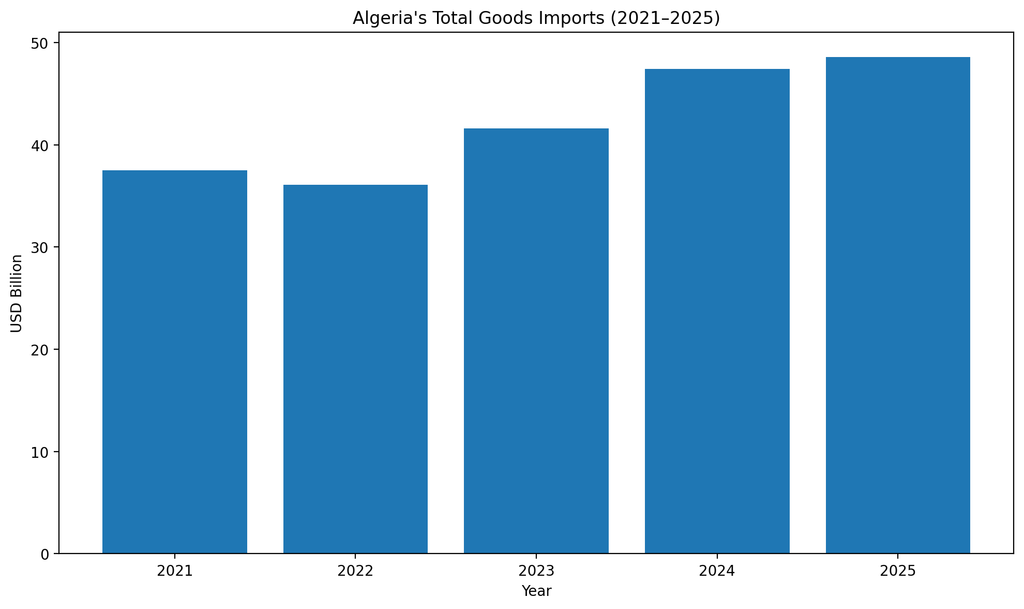
According to the International Trade Centre (ITC) Trade Map, Algeria’s total merchandise imports evolved as follows:
Algeria’s total goods imports (2021–2025)
In USD billions, rounded
$0$15B$30B$45B$60B20212022202320242025
Imports grew from approximately USD 37.5 billion in 2021 to USD 48.6 billion in 2025, an increase of around 29.6%.
After a slight decline in 2022, imports recovered in 2023 and continued growing over the following two years. This development reflects both domestic demand and investment in productive sectors.
Liste des produits importés par l’Algérie
+1
2. What Are Algeria’s Main Imported Products?
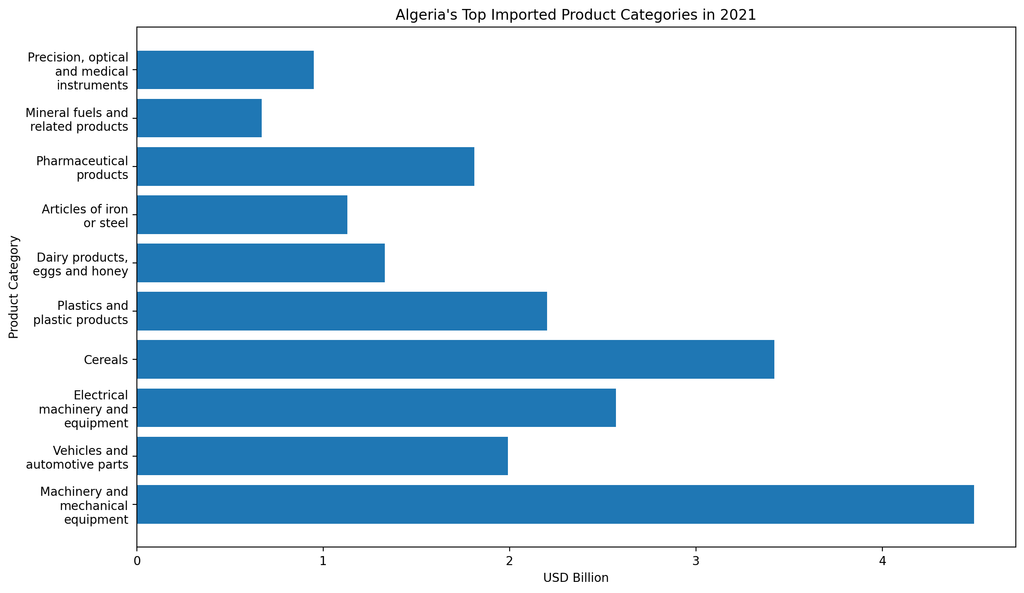
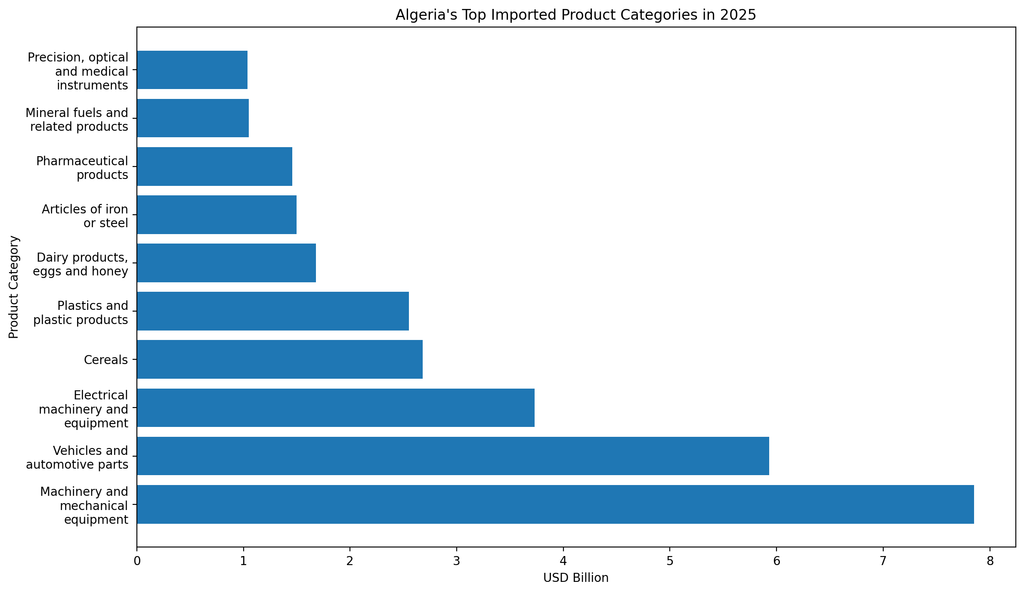
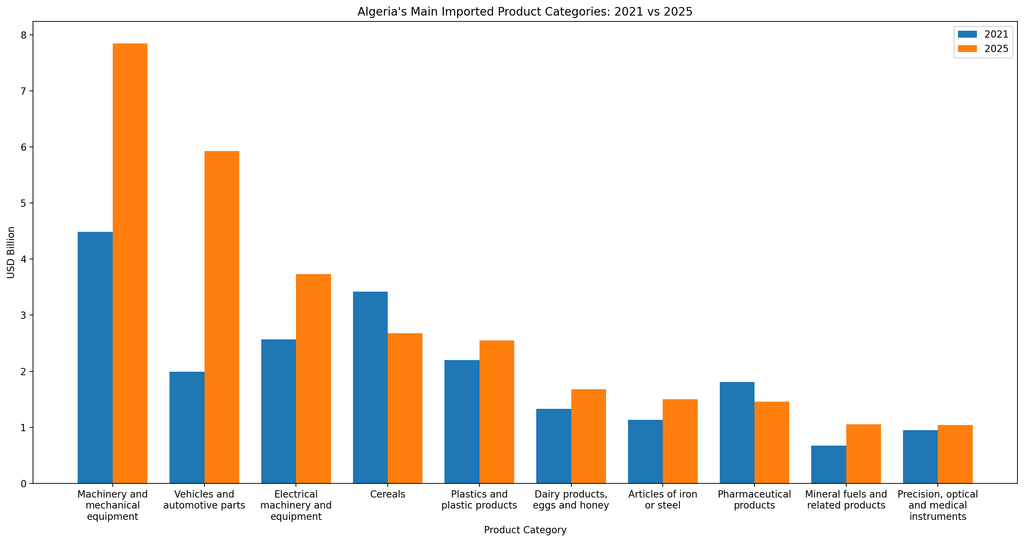
The following table presents the ten largest product categories imported by Algeria in 2025, compared with their values in 2021.
| Imported product category | 2021 | 2025 |
|---|---|---|
| Machinery and mechanical equipment | $4.49B | $7.85B |
| Vehicles and automotive parts | $1.99B | $5.93B |
| Electrical machinery and equipment | $2.57B | $3.73B |
| Cereals | $3.42B | $2.68B |
| Plastics and plastic products | $2.20B | $2.55B |
| Dairy products, eggs and honey | $1.33B | $1.68B |
| Articles of iron or steel | $1.13B | $1.50B |
| Pharmaceutical products | $1.81B | $1.46B |
| Mineral fuels and related products | $0.67B | $1.05B |
| Precision, optical and medical instruments | $0.95B | $1.04B |
Source: ITC Trade Map, UN Comtrade-based statistics. Values rounded to USD billions. Product categories correspond to HS two-digit chapters.
Liste des produits importés par l’Algérie
Several important observations emerge from these figures.
Industrial equipment is becoming increasingly important. Imports of mechanical machinery increased by approximately 75% between 2021 and 2025, while electrical equipment imports also grew considerably.
Vehicle imports experienced particularly strong growth, reaching almost USD 6 billion in 2025. The category includes passenger vehicles, commercial vehicles, tractors and automotive components.
Food imports remain substantial, particularly cereals and dairy products, despite national efforts to increase agricultural production.
These figures show that Algeria’s import requirements extend well beyond consumer goods.
3. Why Does Algeria Import So Much Industrial Equipment?
One of Algeria’s main economic objectives is to develop domestic manufacturing and reduce its long-term dependence on imported finished products.
The government has promoted investment in manufacturing, agriculture, mining and energy infrastructure.
These industries require production machinery, industrial spare parts, electrical systems, processing equipment and specialised technologies that are not always available from local manufacturers.
According to the World Bank, non-hydrocarbon economic activity has been supported by investment and domestic consumption. This helps explain why equipment imports have remained strong.
World Bank
+1
For foreign exporters, this creates opportunities in industrial machinery, factory equipment, agricultural technology and technical services.
However, higher machinery imports do not necessarily mean that all industrial sectors are growing at the same rate. Some imports also serve maintenance, replacement and infrastructure projects.
4. Food Imports: A Continuing Need Despite Agricultural Development
Agriculture remains a strategic sector for Algeria, but local production cannot consistently satisfy all domestic demand.
Cereals are a particularly important example.
Algeria imports large quantities of wheat and other grains to support the country’s bread, pasta, animal feed and food-processing industries.
The main reasons include limited rainfall, recurrent droughts, agricultural production fluctuations and substantial domestic consumption.
The US Department of Agriculture estimated Algeria’s wheat import requirements at approximately 9.2 million tonnes for the 2025/2026 marketing year.
USDA Foreign Agricultural Service
+1
Dairy products are another major category, with imports reaching USD 1.68 billion in 2025.
This reflects the continued importance of imported dairy ingredients and products in supplying the domestic food market.
For international suppliers, the agri-food sector therefore remains important, particularly in cereals, dairy ingredients, animal feed and food-processing technologies.
5. What Do These Imports Tell Us About Algeria’s Economic Direction?
Algeria’s import statistics suggest three major economic priorities.
First, developing domestic production. The country increasingly needs machinery, technology and industrial inputs to support local manufacturing. The objective is to manufacture more products domestically rather than import all finished goods.
Second, strengthening food security. Agriculture and food processing remain strategic priorities because of climate constraints and the need to maintain a stable food supply.
Third, diversifying the economy beyond hydrocarbons. Algeria is investing in manufacturing, mining, agriculture and infrastructure to reduce its dependence on oil and gas revenues.
The International Monetary Fund has identified economic diversification, import substitution and the promotion of non-hydrocarbon exports as important components of Algeria’s economic strategy.

International Monetary Fund
+1
Nevertheless, this transition also presents challenges. Import restrictions, administrative procedures, access to foreign currency and the cost of imported inputs can affect local businesses and international trade.
The IMF has also highlighted the need for a more competitive business environment and greater private-sector participation.
6. What Opportunities Does the Algerian Market Offer Foreign Exporters?
The import figures confirm that Algeria remains an important destination for international suppliers, especially those operating in industrial equipment, automotive components, food products, pharmaceuticals, chemicals and manufacturing inputs.
The most promising opportunities are not necessarily limited to selling finished consumer goods.
Foreign companies capable of supplying machinery, production technology, spare parts and raw materials may benefit from Algeria’s efforts to expand local production.
At the same time, exporters need to understand the country’s import regulations, banking requirements and international payment procedures before entering commercial agreements.
Conclusion
Between 2021 and 2025, Algeria’s import market grew from USD 37.5 billion to USD 48.6 billion.
The most significant development is the increasing importance of industrial machinery, vehicles and electrical equipment, alongside the continued need for food products, pharmaceuticals and industrial materials.
Algeria is pursuing an economic transition from dependence on imported finished products toward greater domestic production, but that transition itself requires substantial imports of equipment and materials.
For international exporters, the Algerian market continues to offer opportunities. Understanding local demand, identifying reliable buyers and securing international payments remain essential to building sustainable business relationships.
Sources: International Trade Centre, Trade Map; World Bank, Algeria Economic Update, June 2025; USDA, Algeria Grain and Feed Annual, March 2025; IMF, Algeria Article IV Consultation, September 2026.